Day 24: Chambers Agree to Amended Budget With Full Salary Supplement Amount Restored
After significant negotiation, the House and Senate reached final agreement on a version of the AFY 2026 Budget which includes the full $2,000 one-time salary supplement payment.
Many thanks to the educators who reached out to legislators, in conjunction with PAGE efforts, in support of restoring the proposed supplement, which at one point in the budget process was reduced to $1,250. If you contacted a legislator about this issue, please follow up and thank him or her for ensuring the full $2,000 supplement was added back to the budget before it was finalized.
In addition to state budget action, the House passed education bills during its floor session, and school-related bills were considered by committees.
Final Version of AFY 2026 Passes with Full $2,000 Salary Supplement Restored

The House and Senate signed off on the Amended Fiscal Year (AFY) 2026 budget which includes the full $2,000 salary supplement for educators and state employees proposed by Gov. Brian Kemp. Rep. Matt Hatchett (R-Dublin), chair of the House Appropriations Committee, outlined key elements of the AFY 2026 budget, including income tax refunds sought by Kemp and property tax relief grants, a priority for House leaders and many members. Over $400 million was added to build a new mental health hospital, a key investment for both chambers. Kemp added $1.25 billion in reserve funds to the AFY 2026 budget to cover these and other items.
The largest change in education funding in the AFY 2026 budget is the $2,000 one-time salary supplement. Other notable changes in education funding include:
$591,965 increase for storm damage repairs at FFA camps
$650,000 increase for facilities to address a bat infestation at an elementary school
$500,000 increase in one-time funds for a planning grant for Southern Rivers Completion High School for up to six new locations
$1.4 million increase to cover state-funded Advanced Placement (AP) exams
$43.9 million increase for enrollment growth in the QBE formula
$16 million increase for the Special Needs Scholarship for enrollment growth
$550,00 increase for one-time funds for an emergency response system pilot in five districts
$2.5 million increase in funds for out-of-school care through the BOOST initiative
$750,000 increase in one-time funds to districts to pilot programs that maximize reimbursement for mental health services
$50,000 increase in one-time funds for youth leadership programming
Legislators did not add $9 million, originally sought by Kemp, to support the development of a career navigator system, instead citing funds in the Technical College System of Georgia (TCSG). They also directed the Governor’s Office of Student Achievement (GOSA) to use $300,250 in existing funds to support America250 literacy initiatives instead of adding funds. They directed the Department of Early Care and Learning (DECAL) to use existing funds to add 25 new Rising Pre-K classes for summer 2026 ($881,000) and expand the extended day program for the Pre-K priority group ($2.4 million).
The budget now goes to Kemp for his review and signature, and budget writers will shift their focus to the FY 2027 budget.
House Passes Math Matters Act and Other Education Bills
The House approved several education bills, sending each to the Senate for consideration:
HB 634 by Rep. Carter Barrett (R-Cumming) clarifies the process for determining the award amount for students who receive a private school voucher through the Special Needs Scholarship program, which is based on their Individualized Education Plan (IEP). The bill also expedites the distribution of the award and specifies the data to include in the program’s annual report, prepared by GOSA. The bill was approved with a vote of 168-0.
HB 1030 by Rep. Sandy Donatucci (R-Buford), the “Math Matters Act,” makes several significant changes to math instruction in Georgia, including requiring the adoption of new math standards, increasing required instructional time, automatically enrolling certain high-performing students in advanced math courses, and imposing new requirements for educator certification. Bill provisions would not be waivable by schools. HB 1030 also requires GaDOE to report various data on student math assessment performance and the number of students enrolled in advanced math courses. The bill was approved 171-0.
HB 1259 by Rep. Matt Dubnik (R-Gainesville) would prohibit local school systems that fail to maintain an average College and Career Ready Performance Index (CCRPI) score of 70 over the last two school years from providing virtual instruction to out-of-district students. The bill also requires school systems to compile a list of out-of-district students enrolled as of Oct. 1 and March 1 of each year. Finally, HB 1259 excludes out-of-district virtual students from equalization funding calculations. The bill was approved 169-0.
Teacher Planning Time and Digital Literacy Bills Approved in House Ed Subcommittee
The Education Subcommittee on Curriculum and Academic Achievement unanimously approved HB 1269 by Rep. Will Wade (R-Dahlonega), which expands Georgia's current online safety standards to include instruction on digital literacy for students in grades K-12. Districts would not be required to create a new course, nor does the bill mandate a certain curriculum. Instead, it allows districts to incorporate instruction on navigating the internet safely and using online tools responsibly into existing courses.
The subcommittee also approved HB 829 by Rep. Arlene Beckles (D-Norcross) which aims to strengthen online safety education by requiring GaDOE to publish guidance on best practices for secure browsing and parental controls. The bill adds information about the dangers of viewing material harmful to minors and age-verification procedures on websites and social media to the subject matter included in model programs for educating students about online safety while using the internet.
House Education Committee Chair Chris Erwin (R-Homer) encouraged Wade and Beckles to consider working together to combine their policy proposals to address student online safety.
The subcommittee also unanimously approved HB 1244 by Rep. Akbar Ali (D-Lawrenceville), which would require school districts to offer teachers planning time and remove districts' ability to waive the requirement as part of a Charter System or Strategic Waiver School System (SWSS) flexibility contract. Language from HB 1231 by Rep. John Corbett was combined with Ali’s bill to clarify that teachers may not be required to supervise students duty-free lunch except in cases of an extreme emergency, which is defined to include events severe weather events, mechanical failures, transportation disruptions, safety threats, or serious staffing emergencies while stating that the lack of a substitute teacher does not qualify. Teachers who voluntarily agree to supervise students during these times outside of an extreme emergency must be compensated at an hourly rate consistent with their salary.
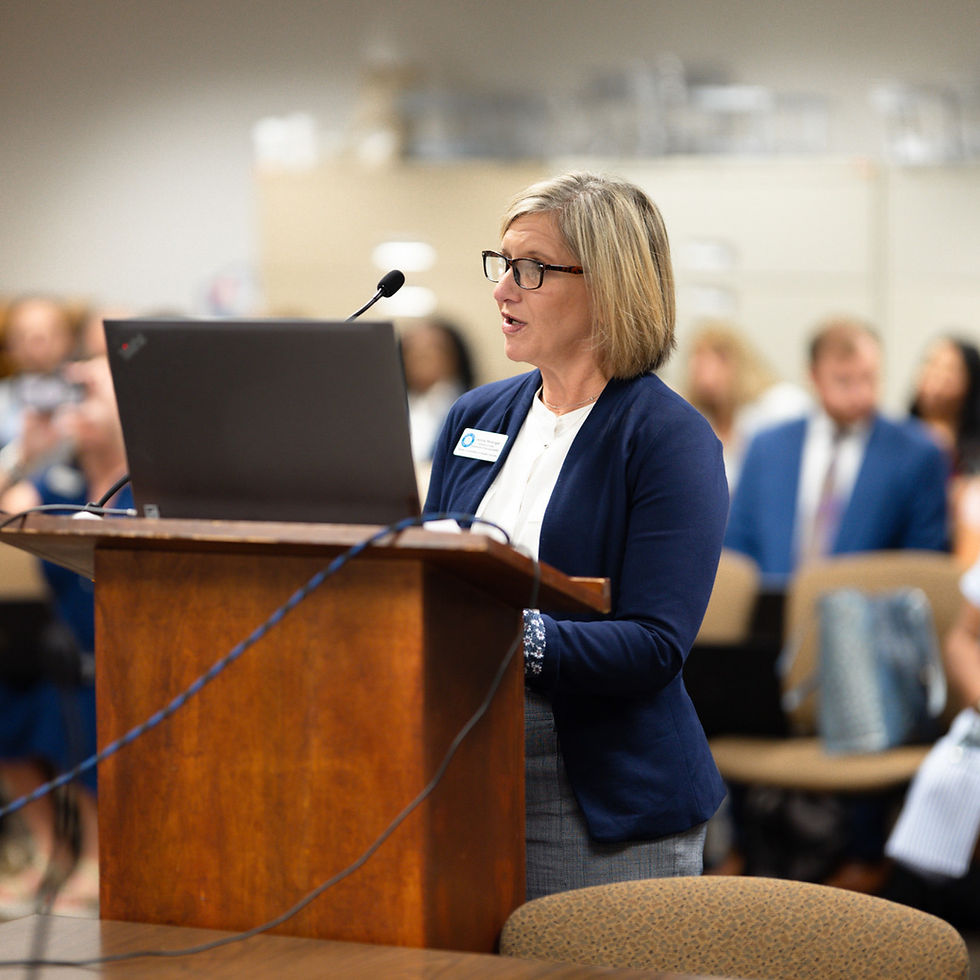
PAGE Director of Legislative Services Margaret Ciccarelli spoke in support of the bill and encouraged committee members to understand that there are multifaceted reasons educators lose planning period or lunch, including professional learning required by state priorities, such as changes to literacy instruction. She also highlighted that substitute pay should be increased to help alleviate burdens on school districts. Finally, in addition to passing HB 1244, Ciccarelli asked committee members to consider creating a study committee to further explore reasons educators miss planning time and other potential solutions to address the issue.
The Subcommittee on Policy & Innovation passed HB 669 by Rep. Steven Meeks (R- Screven). The bill streamlines the ability of local school systems to access capital outlay funds for the purposes of roof improvements by using cooperative purchasing organizations and agreements. The bill now awaits consideration by the full House Education Committee.
The same subcommittee also heard but took no action on HB 60 the “Healthy Start Act” by Rep. Imani Barnes (D-Tucker), which would modify policies and funding procedures to leverage federal and state funds so that schools are able to provide lunch and breakfast to Georgia students including using to state funds to provide free meals to students who qualify for reduced price meals under federal and state guidelines. The bill also encourages use of Georgia-grown products in school meals. During the presentation, it was stated that the bill would cost the state $227 million to implement.
House Higher Ed Continues Hearings on Antisemitism Bill
The House Higher Education Committee heard lengthy testimony but took no action on HB 1363 by Rep. Deborah Silcox (R-Sandy Springs), which creates a statewide coordinator position within GaDOE to handle student complaints regarding discrimination, antisemitism, or racism.
Upcoming Schedule
Thursday, Feb. 26 - Legislative Day 25
House Education, 1 p.m., 506 CLOB
Monday, March 2 - Committee Workday
House Education Appropriations, 10:30 a.m., 341 CAP