Committee Workday: Many Education Bills are Considered--Most Pass
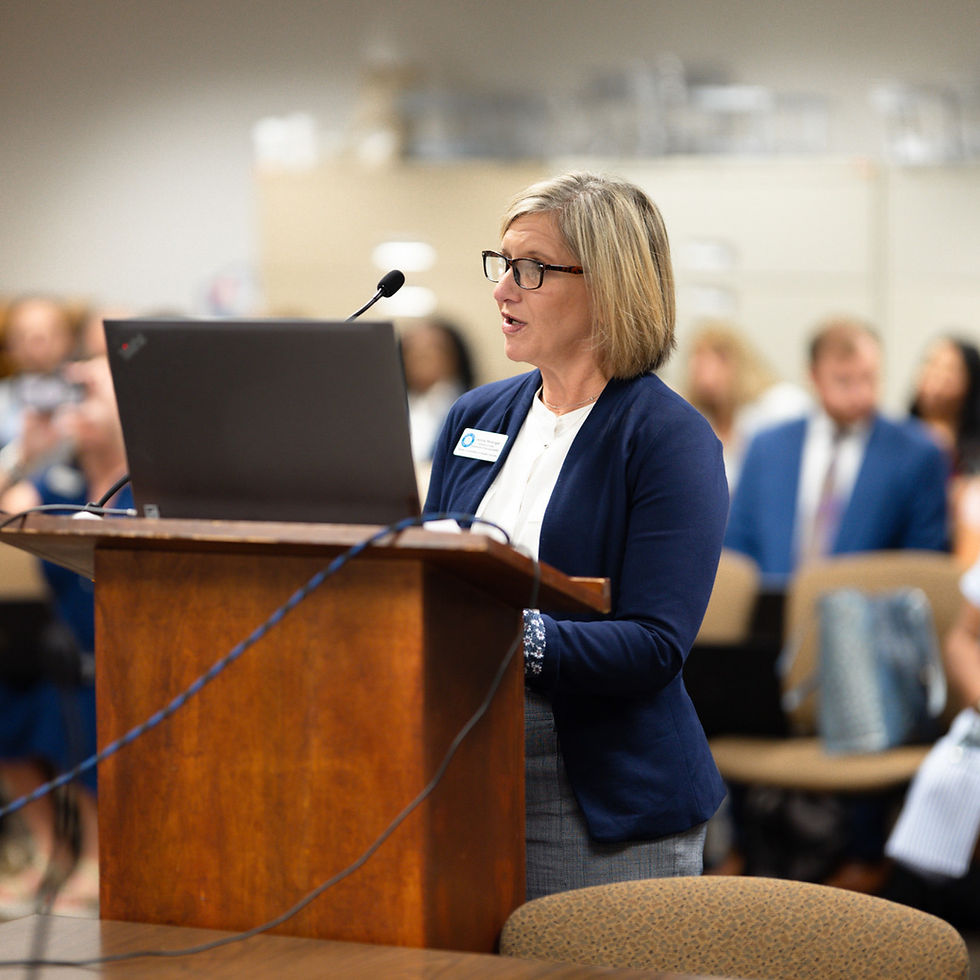
Though the House and Senate were not in session today, many education bills were considered in committee.
In follow-up to today's robust education-related committee action, a very busy education day is expected tomorrow on Legislative Day 23, when the House is slated to vote on literacy legislation, high school cell phone bans, a return-to-work bill, a student-teacher grant pilot, a weapons detection system mandate, and more school-related legislation.
Education Subcommittees Advances GOSA Overhaul, Vision & Hearing Screener Requirements, and Many Other Bills

Both subcommittees of the House Education Committee met today and advanced multiple bills.
Policy & Innovation Subcommittee
HB 1045, the You Are Not Alone Awareness Act, by Rep. Tangie Herring (D-Macon), would require student identification badges in grades 6-12 to include specific language about the 988 suicide and crisis hotline. The bill was amended to add challenges with substance abuse to the list of issues that could be addressed via the hotline.
HB 1402 by Rep. Leesa Hagan (R-Lyons) would require public schools to administer vision and hearing screeners to all students in grades Pre-K through third grade. Schools are required to notify parents if their child fails a screening and report specific information regarding screener results to the Georgia Department of Public Health (DPH). The bill would provide a one-time grant of up to $15,000 to local school systems to purchase needed screening equipment. Grants would be subject to appropriation. HB 1402 would also require local school governing authorities to provide written notification to the parents of children who do not achieve grade-level reading proficiency in third grade. The substitute version of the bill presented in committee is available HERE.
HB 1206 by Rep. Todd Jones (R-South Forsyth) would require local boards of education and other public school governing bodies to consider the total cost of ownership, including repair costs, flexibility for innovation, and anticipated resale or salvage value, when purchasing school technology devices. The bill further requires local school governing authorities to submit a report to the Georgia Department of Education (GaDOE) on the total number of technology devices in use and the rate and cost of their repairs. The bill was amended to narrow its applicability to devices costing $100 or more and to change the reporting deadline to Oct. 15 of each year.
HB 1327 by Rep. Jason Ridley (R-Chatsworth) mandates the installation of at least one exterior key box at every public and private school building. The bill also outlines requirements for these installations and provides schools and their employees with civil liability immunity for any damages arising from the installation and use of the key boxes. Committee members had a variety of questions about the bill's practical details, and it was suggested that the bill would be modified as it moved through the legislative process.
HB 1308, by Rep. Deborah Silcox (R-Sandy Springs), would expand and enhance charter schools’ ability to acquire unused public school properties. The bill changes the definition of “unused facilities” to include properties that are not in use or not used as educational facilities, provided that at least 60% of the space was dedicated to direct student instruction within the previous two school years. It requires local boards of education to make such unused properties available for the use or purchase of both local and state charter schools. If a local board and a charter school do not agree on terms for the use of an unused facility, the Office of Charter School Compliance will mediate the dispute. The bill provides for an appeals process if a local board denies a charter school's request to use an unused facility. Charter schools or charter petitioners would be entitled to compensation if a local board reopens the unused property, or if their petition to lease, use, or buy the property is denied by all available authorizers. HB 1308 was amended to clarify that facilities are to be sold at market value. During the subcommittee discussion, it was also noted that the bill’s definition of “unused facilities” may need to be refined to avoid unintentionally capturing facilities used as administrative offices.
Curriculum and Academic Achievement Subcommittee
HB 1302, by Rep. Matthew Gambill (R-Cartersville), the Education and Workforce Strategy Act, is a workforce development initiative of Gov. Brian Kemp’s. The bill renames the Governor’s Office of Student Achievement (GOSA) the Governor’s Office of Education and Workforce Strategy and expands the agency’s role in aligning education, workforce development, and data governance across state agencies. The bill ends the Alliance of Education Agency Heads and establishes a new statewide education and workforce planning process, the Education Data Governance Board, to coordinate cross-agency data sharing and workforce development policy alignment.
The bill renames and revises the state’s apprenticeship initiative as the Top State for Talent Pre-Apprenticeship and Apprenticeship Program and designates the Technical College System of Georgia (TCSG) as the state apprenticeship agency. TCSG would collect and track data on all registered apprenticeship programs in Georgia. Several representatives of the development industry, specifically those offering private apprenticeship programs, expressed concern about this aspect of the bill, saying they fund their programs with private dollars, and they are already required to report data to the US Department of Labor. Gambill was receptive to the criticism and offered to work with concerned parties on a solution prior to the full House Education Committee later this week. The bill was approved by a vote of 7-3, with Democrats voting against it. They said they support the bill but could not vote in favor without the requested changes.
HB 1284 by Rep. Deborah Silcox (R-Sandy Springs) would require high school diplomas to be awarded to students diagnosed with terminal medical conditions and receiving end-of-life care. The bill outlines the process and procedures for requesting and awarding these diplomas and states that, while every effort should be made to award the diplomas before the student’s death, they may be awarded posthumously. The bill was amended in committee to name the proposed law after a Georgia student who passed away from a terminal illness after the student's mother testified in support of the bill.
HB 1114 by Rep. Bill Yearta (R-Sylvester) would allow Georgia high school students to complete the required financial literacy course as early as ninth grade, starting in the 2026-2027 school year. Currently, students can only complete this requirement in the 11th and 12th grades.
All bills now await consideration by the full House Education Committee
The Curriculum and Academic Achievement Subcommittee heard, but took no action on HB 118 by Rep. Rick Townsend (R-Brunswick) which requires childcare and family childcare learning centers to maintain a portable airway clearance device. It also requires these centers to ensure that their employees are certified in CPR within 45 days of employment. Representatives from multiple healthcare and childcare organizations expressed concerns about the bill and noted that the FDA has not approved or recommended these devices.
Senate Ed Passes Cursive and Non-Instructional Service Mandates but Holds Charter Bill Due to Questions Over Local Referenda on Dissolution of City School Districts
SB 425 by Sen. Marty Harbin (R-Tyrone) requires all schools serving students in grades three, four, or five that receive state funding provide instruction in cursive handwriting to all students no later than third grade. During committee discussion, Sen. Greg Dolezal (R-Cumming) expressed support for the concept but requested that Sen. Harbin consult practicing educators before the bill moves to the Senate floor to prevent unintended consequences. Dolezal questioned whether the mandate would be appropriate at specialty schools serving struggling readers. Sen. Bo Hatchett (R-Cornelia) asked Harbin how the legislation would fit with Georgia’s ongoing literacy initiative. The bill passed unanimously and will next be considered by the Senate Rules Committee.
SB 475 by Sen. RaShaun Kemp (D-Atlanta) requires local boards of education to treat local charter schools no less favorably than other local schools for purposes of the proceeds of special purpose local option sales tax (SPLOST). A last-minute substitute version of the bill presented in committee today also included provisions requested by Senate leadership, lowering the percentage of eligible voters needed to trigger a local referendum on dissolving a city school district into a county district. The current threshold to do so is 25%, and the new provisions of SB 475 would lower that percentage to 10% of eligible registered voters. After one committee member attempted to remove the bill provisions regarding referenda to dissolve a city district and multiple committee questions about the logistics of the current referenda law, the committee decided to seek clarity and reconsider the bill at tomorrow’s planned Senate Ed meeting.
SB 497 by Sen. Clint Dixon (R-Buford) would require written notification to a parent when a student receives non-instructional services. The legislation requires schools to document each time a service is provided to a student that becomes a part of the student’s record. Dixon mentioned the bill contains a hold-harmless clause for emergency situations where a student is at risk of self-harm or harming others. A representative from Georgia Appleseed shared concern that SB 497 would have the unintended effect of infringing on family rights by moving non-instructional services into a students’ file. Similar concerns were expressed by a national suicide prevention advocacy group. The bill passed with two dissenting votes after no committee discussion. It moves to the Senate Rules Committee.
Senate Finance Considers PAGE-Supported Teacher Tax Credit Reauthorization
The Senate Finance Committee discussed but did not pass SB 515 by Sen. Billy Hickman (R-Statesboro), PAGE-supported legislation to reauthorization and modify a tax credit at low performing and rural schools. The program will expire this year without reauthorization. SB 515 redefines eligible schools and caps them at 100 and would lower the tax credit for educators not already receiving the $3,500 tax credit to for up to 5 years. It increases the cap on number of teachers who can participate from 1,000 to 1,200. If more than 1,200 teachers apply, those in rural schools will be priority. Hickman’s legislation requires participating teachers to teach in statewide high needs areas of math, special education, CTAE or reading, writing, or ELA provided, however, that qualifying teachers hold a current GaPSC-approved dyslexia or reading endorsement.
The committee has requested a fiscal note on SB 515 and is likely to consider this legislation again soon.
Dual Achievement Program Changes Approved & Antisemitism Bill Heard for First Time in House Higher Ed
The House Higher Education Committee approved HB 1293 by Speaker Pro Tem Jan Jones (R-Milton), which removes the pilot status of the Dual Achievement Program and makes changes to requirements to enter the program. Jones changed the bill to ensure that students eligible to participate in the Dual Achievement Program in metro Atlanta districts that will not be included in a completion special school consortium will be able to continue participating in the existing programs. The bill was approved unanimously and moves on to the House Rules Committee.
HB 1363, by Rep. Deborah Silcox (R-Sandy Springs), creates a statewide coordinator position within GaDOE to handle student complaints regarding discrimination, antisemitism, or racism. Silcox said many school districts struggle to handle these types of complaints, and the bill is intended to give districts a framework for doing so. The House Higher Education Committee holds two hearings on each bill before voting. According to Committee Chair Chuck Martin (R-Alpharetta), HB 1363 will be considered for a vote at Wednesday’s scheduled committee meeting.
Public School Tax Credit Increases Passes Committee
The House Ways & Means Committee passed HB 565 by Rep. Rick Townsend (R-Brunswick). The bill would increase the cap on the PEACH Education Tax Credit from $15 million to $25 million. The bill now awaits consideration by the House Rules Committee
Elected Superintendent Constitutional Amendment Approved by House Committee
The House Government Affairs Committee approved HR 1348 by Rep. Alan Powell (R-Hartwell) which proposes a constitutional amendment to allow the General Assembly the ability to pass local laws allowing for the election of superintendents if first approved by local referendum. The amendment would also clarify that the qualifications, duties, and salary of the school superintendents shall be established by the board of education. The resolution now awaits consideration by the House Rules Committee.
Upcoming Schedule
Tuesday, Feb. 24 - Legislative Day 23
Senate Retirement, 1 p.m., 406 CLOB
Joint Retirement, 2 p.m., 406 CLOB
Senate Education & Youth, 2 p.m., 307 CLOB
Senate Higher Education, 3 p.m., 307 CLOB
Wednesday, Feb. 25 - Legislative Day 24
Thursday, Feb. 26 - Legislative Day 25