PAGE Shares Reasons Behind Teacher Attrition to HouseStudy Committee
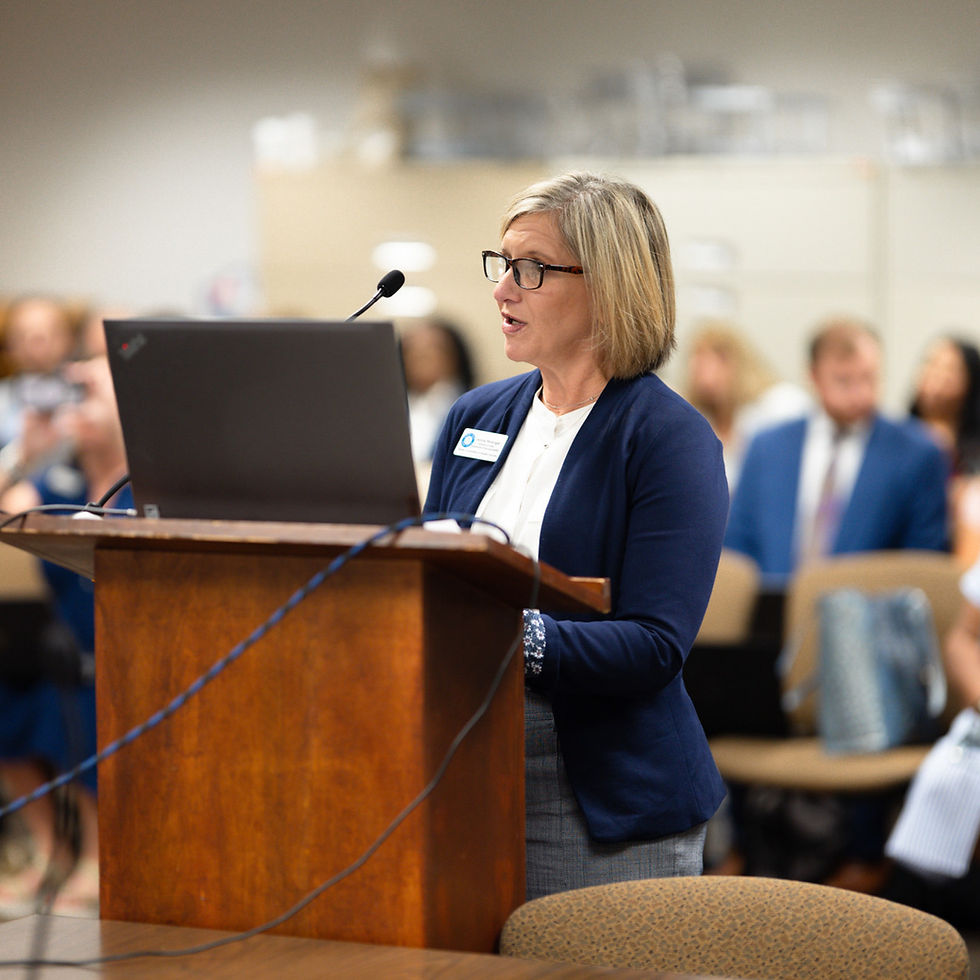
The House Blue-Ribbon Study Committee on Education Performance Metrics and Workforce Stability held its fourth meeting Sept. 30 in Johns Creek. PAGE again presented to the committee, this time on non-salary-related causes of teacher attrition. At a previous committee meeting, PAGE focused on the need to add a step beyond 21 years to the state salary schedule. That footage is available HERE.
The committee is chaired by Rep. Bethany Ballard (R-Warner Robins) and has a dual focus on studying Georgia's state accountability assessment, the College and Career Ready Performance Index (CCRPI), and strengthening the educator workforce.
PAGE Outlines the Reasons Behind Teacher Attrition


Margaret Ciccarelli, PAGE director of legislative services, and Claire Suggs, PAGE senior policy consultant, presented again to the study committee. During the previous meeting, they illustrated how additional state-funded salary steps could help retain veteran educators. The Sept. 30 presentation focused on non-salary reasons driving teacher attrition. Most of the data used in this presentation was drawn from the PAGE 2025 Educator Workforce Survey Report.
Ciccarelli and Suggs stated that several factors influence teacher attrition rates and then went on to detail each factor.

Beyond these factors, Ciccarelli and Suggs elaborated on unique challenges faced by districts with a high number of students in poverty. These districts face higher turnover and generally have more new teachers or teachers on provisional certification. Special education teachers also received attention, as survey data show many students who study special education never enter the field, and over a quarter of those who did enter the field plan to leave it in the near future. Ciccarelli and Suggs concluded their presentation by providing several recommendations to improve teacher retention

Ciccarelli and Suggs highlighted PAGE's New Teacher Initiative Report, which provides several recommendations for better supporting new teachers in Georgia, including student teacher stipends.
Fulton County Staff Address CCRPI Readiness Component


Mike Looney, superintendent of Fulton County Schools, shared statistics from his district, including enrollment, CCRPI scores, and graduation rates. Kim Richards, executive director of strategy and data intelligence at Fulton County Schools, spoke on the Readiness component score of CCRPI. She explained how the component is calculated and suggested that the current method is overly complex and unclear to parents. Richards also suggested that the Readiness component should be weighted more heavily and test scores should be weighted less in CCRPI. Finally, Richards emphasized that schools do not receive their CCRPI scores in time to take effective action. Looney and Richards concluded their presentation by providing several recommendations to improve CCRPI.

GOEWS Explains How CCRPI Scores are Calculated

MJ Kim, director of policy, research, and evaluation at the Governor’s Office of Education and Workforce Strategy (GOEWS), provided the history of CCRPI and how responsibility for the score became shared between GOEWS and the Georgia Department of Education (GaDOE). She presented a detailed breakdown of the CCRPI calculation process, including how the component scores are weighted in calculating the overall CCRPI score. Kim emphasized the data validation processes undertaken by GOEWS. She also outlined various CCRPI-based deliverables. Kim concluded by requesting that GOEWS be consulted in any consideration of changes to Georgia's Every Student Succeeds Act (ESSA) plan or any other item involving data handled by the agency, as this would allow GOEWS to implement those changes more effectively.

GaDOE Details School Climate Star Ratings

Justin Hill, deputy superintendent for whole child supports at GaDOE, spoke briefly on the School Climate Star Rating before fielding questions from committee members. Rep. Chuck Martin (R-Alpharetta) and Rep. Leesa Hagan (R-Lyons) expressed concern about the parental survey component of the rating, as low response rates can skew the score. Hill noted that parent surveys only constitute a relatively small portion of the Climate Rating. Rep. Ballard asked if the Climate Rating could have the unintended consequence of incentivizing educators and schools to underreport disciplinary incidents to avoid negative consequences. Hill responded that the rating had been recently changed to help combat these issues.
Fulton Board of Education Leader Addresses Committee

At the conclusion of the meeting, Fulton County Board of Education President Kristin McCabe briefly addressed the committee, echoing several previously expressed sentiments, including concerns about climate scores on a few parental surveys and the view that test scores should carry less weight in evaluating schools than other factors.